


The Best AI Agents for GTM Engineering (Your 2026 Stack Guide)
The Best AI Agents for GTM Engineering (Your 2026 Stack Guide)
AI agents have quietly taken over the top of the GTM funnel. In 2026, the best AI agents for sales don't just automate tasks they prospect, research, write, and follow up autonomously, around the clock, across email and LinkedIn simultaneously.
The market has split into three distinct categories:
- Plug-and-play AI SDRs that replace human reps out of the box
- Research and enrichment agents that feed your outbound with better data
- Developer frameworks that let GTM engineers build custom agents from scratch.
A fourth category is emerging fast: MCP-powered agents that give AI models like Claude direct programmatic control over tools like LinkedIn automation platforms.
Whether you're running outbound for multiple clients, trying to book meetings without hiring SDRs, or building automated workflows from the ground up, there is the right agent for your stack.
Best AI agents for lead gen agencies
When you run a lead gen agency, you have to do so many things at once: scrape leads, enrich data, write emails, keep all the tools in check, and all of that for multiple clients at once. Yep, I've been there.
That’s why I’ve been so thrilled since I discovered AI agents. They are like tiny SDRs and researchers who work 24/7 and handle the boring, repetitive tasks so you can focus on what matters. These lead generation tools can uncover surprisingly good leads, personalize outreach, and help you achieve what you intended, without hiring new people.

Check out our Omnichannel Lead Generation Strategies guide.
1. Persana AI (Autopilot 2.0)
⚠️ Note: Persana AI recently announced it is joining forces with Rox, which may affect the platform's roadmap and availability going forward.
A next-gen GTM engine that deploys fully autonomous AI agents to automate B2B outreach, from prospecting to conversion. These agents, trained on your unique strategies, tone, and workflows, operate 24/7 across email, LinkedIn, ads, CRM systems, and data enrichment tools.
Key features:
- Full‑funnel GTM capability; no need to switch between tabs or tools
- Agentic workflows (Quantum Agents): Multi-agent orchestration enables custom GTM agents tailored to different business stages
- Uses 75+ buyer signals (firmographic, technographic, behavioral) to engage prospects at optimal times
- Covers 100+ data sources for contact and company enrichment
- Built-in smart email warm-up to ensure high inbox placement and low bounce rates — no third-party tools needed
- Agents replicate your reps' styles and messaging, dynamically adjusting based on prospect behavior
- Integrates with HeyReach to push enriched, personalized leads directly into your outbound flow, powered by 75+ data sources and AI agents
- SOC 2-level security and GDPR compliance
- Real-time reporting and activity logs for full visibility
Pros:
- Agents operate 24/7, boosting meetings and pipeline
- All-in-one platform covering lead gen, data enrichment, AI personalization, and automation — affordable compared to building a multi-tool stack
- Integrates with HeyReach to push enriched, personalized leads directly into your outbound flow, powered by 75+ data signals and AI agents
- Flexible workflows cater to multiple verticals (SaaS, healthcare, manufacturing, etc.)
- Access to 100+ data providers, with unlimited people & company enrichments on all plans
Cons:
- Full potential may require onboarding support and setup time
- Credits cover both data enrichment and outreach usage
- Agentic workflows are promising but relatively fresh; the feature set evolves
- Persana's merger with Rox introduces some uncertainty around the platform's future direction
Pricing:
Persana offers a credit-based pricing model. All prices below are billed annually:
- Free – 50 credits/month; ideal for testing
- Starter – $68/month (billed annually) — 24,000 credits/year; includes credit rollover, web scrapers, and prompt library
- Growth – $151/month (billed annually) — 60,000 credits/year; adds email sequencing integrations (Smartlead, Instantly, Salesloft), webhooks, and company lookalike finder
- Pro – $400/month (billed annually) — 216,000 credits/year; unlocks CRM syncing (HubSpot, Salesforce), ABM, real-time intent tracking, and funding data
- Unlimited – $600/month (billed annually) — 600,000 credits/year; includes Autopilot AI Agents, unlimited exports, and white-glove Slack support
- Enterprise – Custom pricing; adds AI SDR (full-service), custom playbooks, and a dedicated account team
Best for: All-in-one outbound automation across multiple clients
2. Clay AI Research Agent
Claygent is Clay's AI-powered research agent, a fully autonomous tool that instantly digs into public web sources (company sites, LinkedIn, blogs, PDFs, filings, etc.) and returns structured insights in seconds. It eliminates hours of manual account research and enriches your outbound strategy at scale.
Key Features:
- Ask questions like "Is this company SOC II compliant?", "Who are their competitors?", "What tech stack do they use?" — and get answers formatted directly in your table
- Scrapes open web info — team pages, blogs, PDFs, and videos — for context-rich insights
- Claygent Builder: build and test prompts, connect your data, and iterate risk-free without spending credits before launching a real run
- Claygent Navigator: interacts with websites like a human — applying filters, filling out search forms, clicking buttons, and retrieving structured data from sites that don't make it easy to access
- MCP server support: connect Claygent to Gong transcripts, Salesforce, Google Docs, and more for first-party context when writing outbound
- 150+ data providers available in one marketplace
- Sculptor: A new feature that lets you build GTM workflows using natural language
- Integrates with Zapier, Make, n8n, and most CRMs via API
- SOC 2 Type II, GDPR, CCPA, and ISO 27001 certified
Pros:
- Instantly replaces manual research, freeing reps to focus on outreach
- Enables highly personalized messaging based on real, company-specific context
- Teams report 80–90% time savings on pre-outreach prep
- Strong community, active Slack, Clay University, and live cohort trainings
- 14-day free trial, no credit card required
Cons:
- Effectiveness depends on how well you craft prompts — there is a learning curve
- New dual billing model (Actions + Data Credits) can be confusing for new users — every platform operation consumes Actions, while marketplace data purchases consume Data Credits separately
- Best suited for data-savvy teams or those willing to invest in GTM Ops
Pricing:
All paid plans include a 14-day free trial:
- Free – $0; 500 Actions/month, 100 Data Credits/month; up to 200 rows per table; includes Claygent and Clay Sequencer
- Launch – starting at $167/mo (billed annually); 15,000 Actions/month, 2,500 Data Credits/month; up to 50,000 rows; includes phone enrichment, signal tracking, and email campaign integrations
- Growth – starting at $446/mo (billed annually); 40,000 Actions/month, 6,000 Data Credits/month; adds CRM auto-sync, HTTP API integrations, webhook automation, web intent signals, and ads audience sync
- Enterprise – Custom pricing; unlimited Audiences, bulk enrichment, data warehouse sync, SSO, RBAC, and a dedicated Growth Strategist
Note: Actions and Data Credits can be topped up at any time without upgrading your plan. Unused Data Credits roll over up to 2x your monthly limit on Launch and Growth plans.
Best For: Instant, structured lead research and enrichment at scale
3. Lindy
Originally marketed as a no-code AI automation platform for teams and agencies, Lindy is now focused on being a personal AI work assistant that manages your inbox, meetings, calendar, and follow-ups. The tagline has shifted from "your next hire isn't human" to "get two hours back every day." It's trusted by 40,000+ professionals and companies like Autodesk, AppLovin, and Turing.
For lead gen use cases, Lindy can still handle email automation, meeting scheduling, CRM updates, and follow-up sequences — but it's now primarily designed for individual professionals rather than multi-client agency workflows.
Key Features:
- Operates via iMessage/SMS: you can text Lindy to get things done from anywhere, 24/7
- Manages inbox automatically and drafts replies in your voice
- Meeting recording, note-taking, scheduling, prep, and follow-up
- Learns your style over time; memories are saved and adjusted based on your preferences and feedback
- Surfaces important context and flags things before you have to ask
- Integrates with hundreds of apps, including Gmail, Outlook, Google Calendar, Slack, Notion, and more
- Enterprise plan includes SSO, SCIM, audit logs, HIPAA-compliant BAA, and AI assistants for entire teams
- SOC 2, HIPAA, PIPEDA, and GDPR compliant
Pros:
- Extremely fast setup takes about 60 seconds, with a 7-day free trial, no credit card required
- Works on both iOS (iMessage) and Android (SMS)
- Automates the repetitive daily tasks that drain time — email, scheduling, meeting prep, follow-ups
- Data is never sold or used to train models; approvals are built in, so Lindy never sends without your review
- Clear pricing with no hidden contracts; cancel anytime on the Plus plan
Cons:
- Lindy has pivoted away from complex multi-agent, multi-client agency workflows — if you need those, it's less suited than before
- The old credit-based model for custom agent builders is gone; the platform is now more of an assistant than a workflow automation engine
- Not built for LinkedIn outreach or multichannel sales sequences
- Enterprise-grade team features (SSO, SCIM, audit logs) require contacting sales
- Current integrations cover the main productivity stack, but custom integrations require the Enterprise plan
Pricing:
- Plus — $49.99/month: Standard usage; includes all core features (inbox management, meeting notes, scheduling, iMessage assistant)
- Pro — $99.99/month: 3x more usage than Plus
- Max — $199.99/month: 7x more usage than Pro
- Enterprise — Custom pricing: Everything in Max, plus SSO, SCIM, audit logs, HIPAA BAA, dedicated support, onboarding, and AI assistants for the whole team
- All plans include a 7-day free trial
Best For: Individual professionals and small teams who want an AI assistant to handle daily inbox, meeting, and scheduling tasks. Not the best fit for agencies managing complex multi-client outbound workflows.
4. Origami Agents
Origami Agents is a YC F24-backed platform that puts AI-powered research agents to work for you — scanning job boards, press releases, social media, filings, product reviews, LinkedIn activity, and more to uncover real-time buying signals. Think of it as your always-on, never-sleeping SDR researcher, feeding you hyper-relevant leads that actually want to buy.
For lead gen agencies, it's a dream: zero manual scraping, full CRM integration, and insights tailored to your clients' ICPs. It's built to make prospecting smarter, faster, and way more scalable.
Key Features:
- Deployable AI agents scan for buying intent signals across unstructured data sources — job boards, social media, press releases, product reviews, Google activity, LinkedIn engagements, company websites, and public records
- AI research is human-reviewed before delivery, ensuring clean, explainable insights rather than raw noise
- CRM Enrichment Agent automatically refreshes existing records with up-to-date contact info, company context, and fresh buying signals — no manual intervention needed
- You can fine-tune agents with filters like company size, industry, location, or keywords
- Agents identify triggers like hiring sprees, tech adoption, leadership shifts, and funding announcements within 24 to 48 hours
- Built-in integrations export leads to Airtable, CRMs like HubSpot and Salesforce, and enrichment workflows
- Covers LinkedIn profile reviews, website scraping, news articles, blog posts, and dozens of niche sources that structured databases miss entirely
Pros:
- Surfaces the 99% of buyer intent signals that exist beyond standard databases like Apollo or ZoomInfo, reaching prospects that competitors simply can't see
- Customized agents provide highly targeted lead signals that conventional tools often miss
- Saves time; agencies can redeploy reps from pure research to strategic outreach
- Users report 4 to 5x more leads found, including contacts not even on LinkedIn, and 40% higher conversion rates with enriched lead data
- Agents available for healthcare, fintech, SaaS, professional services, e-commerce, and more
- Human QA layer on results means cleaner data going into your CRM
Cons:
- Not a complete outbound solution — you still need enrichment and email tools, though it integrates with HeyReach to help fill the gaps
- No multichannel engagement; Origami finds leads, but doesn't message them
- Very early-stage company; limited long-term track record and fewer public reviews than established players
- Creating the right signal filters takes time and experimentation
- Pricing is available on request only, which can make budget planning harder
Pricing: Available on request.
Best For: Real-time buying signal detection and smart prospecting — especially for teams targeting accounts that standard databases miss
5. Telescope
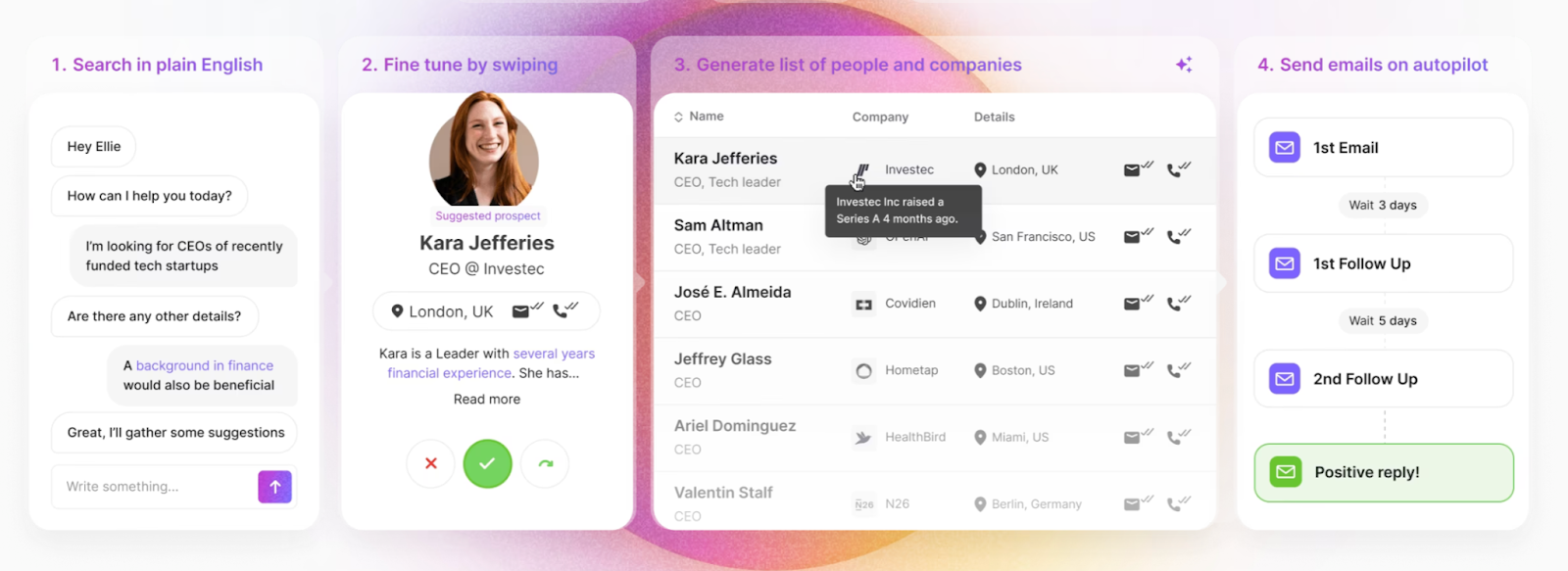
Telescope is an AI-powered, all‑in‑one lead-generation platform that lets you describe your ideal prospect in natural language and the message you want to send. It then automatically builds qualified lead lists, enriches contacts, handles email and LinkedIn outreach (warm-up, send, and monitor), and feeds responses into your CRM, all in one place.
Key Features:
- Natural-language search (e.g., "Seed-stage SaaS companies hiring sales reps")
- Telescope Agent goes beyond standard filters — define hyper-specific criteria in plain language (e.g., "SaaS company with at least 2 PMs and usage-based pricing") and get matched leads with reasoning for each fit
- Built-in contact database provides access to 900M+ person profiles and 50M+ company profiles across 100+ countries, with a <1% bounce rate
- Waterfall enrichment powered by 15+ data providers for maximum contact coverage and domain protection
- Upload your top customers to train an AI agent that surfaces lookalike companies and contacts at scale
- AI generates custom, personalized messages based on each lead's context, role, or company profile
- Multichannel outreach: email and LinkedIn in a single sequence
- Dynamic warm-up, ramp-up, and cool-down to protect sender reputation and hit 95%+ inbox placement
- Unified Master Inbox consolidates all email and LinkedIn replies in one place, with AI auto-categorization (Hot Lead, Follow Up, Meeting Scheduled, etc.)
- Full CRM integration (HubSpot, Salesforce, Pipedrive) available from the Scale plan and above
Pros:
- Users report 5x faster prospecting and tasks that took a full day now take under an hour
- Email + LinkedIn automation in one platform, which is rare at this price point
- Automated domain and mailbox setup removes all deliverability headaches — DNS, warmup, and monitoring handled out of the box
- All‑in‑one workflow, from list building to outreach to CRM sync
- Backed by Soma Capital, Redseed, and Mento; GDPR compliant; registered in London
- Cancel anytime; unused credits roll over up to 2x monthly limit
Cons:
- Credits are used for leads, emails, LinkedIn messages, and phone data; usage can add up fast, especially with multi-step sequences
- To get the best results from Telescope Agent, you'll need to fine-tune prompts and criteria
- CRM integration is only available on the Scale plan ($1,999/mo) and above
- LinkedIn automation requires the Scale plan
Pricing:
- Free — 50 credits/month; no credit card required. Includes AI prospecting, natural language search, and email outreach via your own connected account
- Telescope One — $47/mo (billed annually) / $59/mo (monthly): 12,000 credits/year (3,000 people in high-touch sequences); email or LinkedIn outreach, AI personalization, master inbox. No in-app domain/mailbox creation or CRM integration
- Telescope Scale — $1,999/mo (billed annually) / $2,499/mo (monthly): 480,000 credits/year (80,000 people in sequences); multichannel email + LinkedIn, 40 free mailboxes with automated setup, 10 LinkedIn slots, CRM integration, dedicated success manager, shared Slack channel, monthly 1-hour consultation
- Telescope Studio — from $4,999/mo (billed quarterly): Unlimited credits and users; fully done-for-you — dedicated GTM engineer, list building, copywriting, technical setup, weekly reports; you only reply to positive leads
Best For: Natural-language-driven list building and multichannel outreach (email + LinkedIn) — all in one platform
6. Agent Frank
Agent Frank is a fully autonomous AI SDR built by a former VP Sales that handles everything from prospecting to meeting booking — no human SDR needed. It operates 24/7 within the Salesforge ecosystem, generating leads, sending personalized outreach across email and LinkedIn, following up, and syncing meetings directly into your CRM.
The Salesforge "Forge Stack" now includes:
- Salesforge (sales execution)
- Leadsforge (500M+ contact search engine)
- Infraforge (private email infrastructure)
- Megaforge (premium multi-ESP infrastructure)
- Mailforge (distributed email)
- Warmforge (deliverability)
- Primeforge (Google & MS365 infrastructure)
This makes Agent Frank a fully self-contained outbound system with no external tool dependencies.
Key Features:
- 24/7, end-to-end outbound automation: prospecting, messaging, follow-ups, and meeting booking
- Auto-Pilot and Co-Pilot modes — choose full autonomy or review messages before sending
- Multichannel outreach: unlimited email mailboxes AND unlimited LinkedIn senders
- Conditional multi-channel sequences that orchestrate outreach across multiple touchpoints and adapt to prospect pain points
- Available in 20+ languages: American English, British English, French, German, Spanish, Japanese, and more
- Fully customizable agent: set goals (click-out, send meeting link, or receive meeting link), operating hours, time zone, personalization sources (website, blog, LinkedIn posts), and tonality (9 options)
- Leadsforge integration gives access to 500M+ contacts directly within the platform for continuous prospecting based on your ICP
- Megaforge — premium infrastructure that auto-distributes sending across Gmail, Outlook, Mailforge, and Infraforge for maximum deliverability with automatic fallback if one ESP burns
- Automatically handles replies, filters unqualified responses, and syncs booked meetings
- Includes a dedicated account manager and shared Slack channel
Pros:
- 15x cheaper than a human SDR — the built-in savings calculator on their site lets you compare full SDR costs vs. Agent Frank
- Unlimited mailboxes and LinkedIn senders — one of the few platforms that doesn't charge per seat or per inbox
- Simple onboarding; 2-week warm-up period runs automatically at no extra cost
- Learns from your knowledge base (product docs, brochures, website) to adapt messaging
- High reply rates (up to 21% in some cases) driven by timing and personalization
- Real-time performance monitoring; dedicated account manager included at all tiers
- Ideal fit for B2B teams selling products with ACVs between $5K–$100K, targeting startups, SMBs, or mid-market
Cons:
- It's an AI SDR, not suitable for Fortune 500 or complex enterprise RFP-based sales cycles
- No free trial, requires a demo before purchase
- 2-week warm-up period before campaigns go live (though it's fully automated)
- Fully tied to the Salesforge ecosystem; switching away means losing the integrated stack
- Not a good fit for highly bespoke, high-touch deals or very small target markets (fewer than 3,000 businesses)
Pricing:
- Base plan: $499/month (billed quarterly) or billed annually to get 2 months free
- 1,000 active contacts included at base — meaning Frank is interacting with 1,000 leads at any given time, translating to 2,000–2,500 new leads reached and 6,000–7,500 personalized emails sent per month
- Scale pricing: $0.25 per contact for 2,000+ contacts/month
- Slider available on the pricing page to configure up to 50,000 active contacts/month
- Email infrastructure (Infraforge or Megaforge) is an add-on, not included in the base price; Infraforge starts at $33/month for 10 mailboxes; Megaforge starts at $69/month for 20 mailboxes
Best For: Autonomous SDR replacement with quick deployment, especially for B2B teams selling to SMBs and mid-market that want unlimited multichannel outreach without hiring or managing a large SDR team
Best AI Agents for Outbound Startup Sales Teams
Startups need a pipeline fast, but building an outbound team takes time and money that most early-stage companies don’t have.
AI sales agents solve that by acting as full-stack SDRs, running 24/7 to research leads, write personalized messages, send campaigns, and book meetings. These agents let you launch outbound in days, not months, without hiring, training, or managing a sales team.
If you want to scale without the overhead, one of these AI tools can be your shortcut.
7. Artisan (Ava agent)
Artisan is a fully autonomous AI SDR platform built to help sales teams run outbound without hiring a full SDR bench. Known for its bold "Stop Hiring Humans" billboard campaign, Artisan has raised $25M in funding and counts 250+ companies among its customers, reaching $5M in ARR. Their flagship AI agent, Ava, fully automates outbound sales, from lead research to reply handling to booking meetings, without ever needing a human to press send.
Think of Ava as your smartest, most tireless BDR: she mines data, writes emails, sends LinkedIn messages, reads and handles replies, answers objections, and hands off warm leads 24/7. No integrations, no juggling tools — just plug into Artisan's all-in-one platform and let Ava run your outbound like a pro.
In addition to Ava, Artisan also offers two more AI agents: Aaron, focused on inbound sales, and Aria, a smart meeting assistant.
Key Features:
- Ava fully automates your campaigns — sets up and runs email + LinkedIn sequences based on your ICP and messaging
- Searches 350M+ verified B2B contacts across 200+ countries with intent-enriched profiles
- Uses firmographic, technographic, hiring, funding, and social signals to personalize every message, including a proprietary database of brick-and-mortar businesses, and a unique edge over competitors
- Ava reads every reply, handles objections, answers questions, and books meetings directly on your calendar. Your reps only talk to prospects who are ready to buy
- Personalization Waterfall Technology crafts unique emails for every prospect using dozens of enrichment sources
- Watchtower / Data Miner monitors intent signals like funding rounds, hiring surges, and news mentions to time outreach perfectly
- Automatically filters out negative replies and passes hot leads straight to your reps
- You can require human review at any stage before going fully autonomous
- Syncs activity to HubSpot or Salesforce; prevents duplicate outreach with blacklist capabilities
- No rip-and-replace needed; integrates with your existing CRM, calendar, and data tools in minutes
Pros:
- Ava now handles the full reply loop: reads, responds to objections, and books meetings autonomously, not just sends emails
- Everything's built into the platform, no integrations or 3rd-party tools required
- Free to start — you can explore the platform and see Ava in action before committing to a paid plan
- Ava handles the grunt work so human reps can focus on closing
- New success-based pricing option via Paid.ai; pay per response instead of signing a long-term contract, so you only pay when you get value
- Teams using Ava report pipeline generation at 1/5th the cost of a human BDR
Cons:
- Real user reviews consistently flag that Ava's emails can feel generic and AI-generated
- Ava cannot make phone calls. She creates call lists and talking points for your reps, but calling is not automated
- Requires 2–3 weeks of active training and refining outputs before teams can confidently run Ava more autonomously
- Annual contracts are standard; some users report friction when trying to cancel
- Not suitable for highly specialized or niche markets
- Pricing is not transparent, requires a sales conversation
Pricing:
Artisan doesn't publish standard pricing. Plans are customized based on team size, campaign complexity, and number of agents deployed. A free trial is available to explore core features before committing.
Best For: Running full outbound campaigns without hiring SDRs — best suited for small to mid-sized B2B teams with standard sales processes and a clearly defined ICP; less effective for niche markets or complex enterprise sales cycles
8. 11x.ai (Alice)
Alice is an autonomous AI SDR built by 11x to take over outbound sales — from prospecting and research to multichannel outreach and meeting booking. She runs 24/7, mines signals from across the web, crafts hyper-personalized messaging, and fills your calendar with qualified buyers. 11x has raised $70M+ from a16z and Benchmark, and has powered hundreds of millions in pipeline for customers, including Xerox, Leica, Checkr, Gupshup, and Sage.
Whether you're reviving closed-lost deals, chasing job-change leads, or entering new markets, Alice does it on autopilot — at 11x the scale of a human rep.
In addition to Alice (outbound), 11x also offers Julian — a dedicated inbound digital worker that handles speed-to-lead, inbound lead qualification, automated meeting scheduling, and customer onboarding operations.
Key Features:
- Tracks every lead in your market in real-time, with a lead scoring engine that surfaces your highest-intent prospects across job changes, website visits, funding signals, and social activity
- Goes beyond traditional contact databases, using live web search and AI prospecting to build context-rich profiles on demand
- Combines deep prospect research with self-improving messaging; leverages behavioral signals to pinpoint each prospect's true pain points and crafts strategic multi-touch campaigns autonomously
- Multichannel sequences — email, LinkedIn, and consented outbound calling, all coordinated in one sequence builder
- Smart Replies — Alice handles replies and objections, not just sends; continuously prospects, handles replies, and schedules meetings 24/7
- AI Phone Agent for inbound handling and intelligent lead routing
- Enriches and cleans CRM data while ensuring outreach avoids duplication or fatigue
- Revives dead and cold leads from your CRM, turning forgotten contacts into new pipeline
- Supports 105+ languages for international expansion
- Proprietary deliverability engine — mailbox management and deliverability infrastructure built in
- G2 integration as a native signal source; targets prospects based on G2 intent data
- Integrates with Salesforce, HubSpot, Pipedrive, Slack, Google Calendar, Outlook, Gmail, and more via API
- SOC 2 Type II and CASA certified
Pros:
- $70M+ raised from a16z and Benchmark, strong institutional backing and enterprise-grade credibility
- Customers report $500K+ saved on hiring costs, 50% lower CPL, 30% more meetings per AE, and 80% improvement in meeting-to-qualified-opportunity rate
- >$100M in revenue generated for customers
- Alice replaces a fragmented stack of 6–8 tools (contact data, intent, engagement, research, personalization, warmup, automation, CRM sync) in one platform
- Multilingual capabilities for easy international campaigns across 105+ languages
- Julian handles inbound alongside Alice's outbound — true full-funnel AI coverage in one platform
Cons:
- No public pricing — requires a demo/sales conversation to get a quote
- Takes some onboarding to understand Alice's full capabilities and where she fits in your GTM stack
- Consented outbound calling is available, but still maturing compared to the more established email and LinkedIn channels
- Best suited for growth-stage and enterprise teams, may be over-engineered for very small or early-stage teams with a limited TAM
Pricing: Available on request. No free trial listed, requires a demo to get started.
Best For: Hyper-personalized, signal-driven outbound at scale, ideal for growth and enterprise teams who want a single AI platform to replace their entire outbound stack, from prospecting to pipeline
9. Unify
Unify GTM offers AI-powered agents designed to fully automate outbound workflows, from signal detection through messaging to pipeline reporting. It brings together buyer intent signals, research, personalization, sequences, deliverability, and analytics in one place. For lean startup sales teams, it's like having a miniature SDR ops team working 24/7 to uncover and engage prospects. Backed by Emergence Capital and the OpenAI Startup Fund.
Key Features:
- Captures and acts on 25+ real-time buying signals, like website activity, intent alerts, new hires, funding events, and social actions
- Build workflows that research, enrich, qualify, and sequence leads automatically, and then let agents run them on autopilot
- Multichannel outreach via email and LinkedIn, backed by managed deliverability and inbox health tools
- Agents scrape web/CRM, enrich contact data, write personalized messages, and auto-qualify leads with transparent logic
- Full visibility into pipeline, sequence performance, and ROI attribution, so you can double down on what works
- Intent signals aggregated from 10+ sources including 6sense, Clearbit, G2, and person-level website intent, reducing the need to check multiple platforms separately
Pros:
- Full-stack outbound in one: Signals → AI research → personalization → sequences → analytics
- Highly customizable & transparent; build Plays using AI logic nodes that log reasoning
- Customers like Perplexity, Together AI, and Justworks report millions in pipeline and 10X ROI in months
- Agents handle data-heavy grunt work; your reps jump in for high-leverage moments
- Managed deliverability includes email warmup, rotation, monitoring, domain health, and high-delivery IP addresses
Cons:
- Credit-based pricing model can get expensive and unpredictable — every action (email reveal, phone number, agent run) consumes credits separately, and costs scale fast with aggressive outbound
- No free plan available
- Annual billing required for Pro and Enterprise tiers — you're committing upfront with limited flexibility to exit early
- Not a full outbound platform — no built-in dialer or chatbot; you'll still need additional tools for phone and live chat
- Doesn't generate whole emails; it's more of a research co-pilot than an end-to-end agent
- No mobile support or standalone desktop version
Pricing:
- Growth plan starts at $700/month, billed annually ($8,400 upfront) — includes 30,000 credits, 2 Active Plays, 3 platform users, 1 email-sending user, and 5 Unify-managed mailboxes
- Custom pricing for Pro and Enterprise plans
- No free plan or free trial available
Best For: Custom outbound workflows powered by real-time signals
10. Docket AI
Docket is a modern agentic marketing and sales enablement platform powered by two smart AI agents: the AI Sales Engineer (Sales Agent) and the AI Marketing Agent. Together, they handle everything from real-time sales answers, RFP automation, and in-meeting support to website conversion, content creation, and lead qualification. It's like giving every seller a top-performing SE and a 24/7 SDR — without adding headcount.
Founded in 2023 and backed by Mayfield and Foundation Capital, Docket is built on their proprietary Sales Knowledge Lake™, which unifies your product, marketing, and sales content into a single, intelligent layer that powers accurate, context-aware automation across the funnel.
Key Features:
- Talks to visitors in human-like conversations — by voice, chat, or visuals — qualifying and converting traffic on autopilot
- Learns more about each repeat visitor over time through unique discovery questions
- Uses real-time slide decks, demos, and images to explain your solution
- Converts leads 24/7: books meetings after hours, routes low-ACV deals to close automatically, and never drops a warm lead
- Sales Knowledge Lake™ ingests data from 50+ sources, including Salesforce, HubSpot, Gong call recordings, Slack, Google Drive, Notion, SharePoint, and product documentation; the more sources connected, the smarter it gets
- Supports 40+ languages for multilingual website engagement
- Responds to inbound leads in under 60 seconds, 24/7 — vs. the industry average of 42–47 hours for human SDRs
- No engineering resources required to deploy — setup takes 5–10 minutes via a simple JavaScript snippet, with full deployment typically complete within 7–14 days
Pros:
- From pre-sale research to closing support, Docket brings end-to-end automation for both reps and websites
- The Sales Knowledge Lake™ ensures answers are enterprise-accurate, not generic AI fluff
- Teams report 33%+ improvements in seller efficiency, 15% more inbound traffic converted into pipeline, and massive RFP time savings
- Improves over time by learning how your best reps respond and sell
- Docket's Customer Success team handles implementation; no internal engineering needed
Cons:
- Startups with lighter sales ops/process complexity may not use the full scope
- Stronger results when your GTM assets and sales documentation are organized and available
- Initial setup requires time to classify product modules and define routing rules, especially for complex multi-product solutions
- Pricing is not publicly listed on the pricing page; it requires a sales conversation
Pricing:
- Available on request for custom quotes
Best For: In-meeting support and lead qualification with sales intelligence — particularly strong for B2B companies with complex products and high inbound website traffic.
11. n8n + AI Agents
n8n (short for "node-based, natural automation") is the most flexible way to build your own AI sales agents from scratch. It's not a tool with prebuilt SDR agents. It's an open-source automation platform that lets you combine AI (ChatGPT, Claude, Gemini, etc.), custom logic, APIs, and 500+ tools such as HubSpot, Slack, LinkedIn, and Notion to create multi-agent workflows.
Whether you're putting together a LinkedIn researcher, a cold email writer, or a CRM sync bot, n8n gives you the building blocks to bring your outbound engine to life. With 162,000+ GitHub stars and over 230,000 active users, n8n is one of the most widely adopted open-source automation platforms in the world.
For startup teams that want full control over how their AI agents work (and don't mind a little configuration), n8n is the DIY SDR toolkit playground.
Key Features:
- Drag-and-drop interface lets you build end-to-end sales workflows using AI, webhooks, CRMs, and enrichment tools
- Supports OpenAI (ChatGPT), Gemini, Claude, Hugging Face, and other AI models via built-in integrations or HTTP nodes
- 800+ workflow templates to launch LinkedIn assistants, chatbot inboxes, or deep research agents in minutes
- 500+ native integrations (LinkedIn, Gmail, Slack, CRMs, Clay, HeyReach), REST API builder, vector DB support, OpenAI/Gemini/Claude plug-ins, and webhooks galore
- SOC2 compliant, role-based access, human-in-the-loop steps, and self-hosting options for full control
- Execution-based billing: a full workflow run (regardless of how many steps it contains) counts as a single execution, making costs far more predictable than per-task tools like Zapier
Pros:
- Extremely flexible — you can build almost any AI agent your way
- Cost-effective, especially for startups with engineering or technical GTM talent
- Integrates with everything from APIs to databases to webhooks
- Lets you experiment and iterate quickly on outbound flows
- All plans now include unlimited users, unlimited workflows, and unlimited steps — you're only billed based on how often your workflows actually run
- Strong community and plugin ecosystem
Cons:
- Not for non-technical users — you'll need to understand nodes, flows, and APIs
- Takes time to build, test, and maintain, especially for smaller teams
- Self-hosting is free but requires DevOps capacity; the new paid Business plan ($800/mo) adds SSO, Git version control, and environments for teams that need them
- UI can be overwhelming for those unfamiliar with automation logic
- Sub-workflows each count as separate executions, which can catch teams off guard when designing modular automation
Pricing:
- Community Edition — Free (self-hosted): unlimited workflows, unlimited executions, unlimited users; requires you to manage your own infrastructure
- Starter — €24/month: 2,500 executions/month, unlimited workflows and users; ideal for solo builders or low-frequency automations
- Pro — €60/month: 10,000 executions/month; adds more concurrent workflows and team features; best for small teams in production
- Business — €800/month (self-hosted, billed annually): 40,000 executions/month; adds SSO/SAML, Git version control, environments, and queue-mode scaling
- Startup Plan: qualifying startups (under 20 employees) get the full Business plan at 50% off (€400/month)
- Enterprise — Custom pricing: unlimited executions, dedicated support, advanced compliance
Best For: Building fully custom SDR agents
12. Make + AI Agents
Make is a powerful no-code/low-code automation platform that lets you build your own AI agents, designed to adapt in real time, automate complex workflows, and scale across your business.
With 3,000+ prebuilt integrations and a visual-first canvas, Make AI Agents plug directly into your sales stack to do the work of SDRs, RevOps, and support staff — all on autopilot. Make is part of Celonis, giving it enterprise-grade backing and security infrastructure.
For startup sales teams that want the speed of Zapier but with far more brains and flexibility, Make gives you the tools to build goal-driven outbound agents without needing to code from scratch.
Key Features:
- Write tailored outbound messages using AI + contextual data pulled from your CRM or enrichment tools
- Kick off sequences based on form fills, job changes, web visits, or product activity
- AI SDR agents automatically qualify leads, respond to questions, and hand off warm leads to your human reps
- Every agent has a global prompt structure you can tweak for consistency or specialization
- You can use OpenAI, Claude, Gemini, Mistral, Perplexity, Azure OpenAI, ElevenLabs, or whatever LLMs fit your use case, switch, or test on the fly
- Full visibility into how agents reason, which tools they use, and how workflows behave, step by step, so issues are easy to spot and correct
- Library of Agents: browse and deploy ready-made AI agent examples instantly, without building from scratch
- Make MCP Server: connect your AI to real business actions securely and visually, directly from external AI tools
- Make AI Web Search (beta) bring live web data into your automations with built-in AI search
Pros:
- No-code first, but dev-friendly
- From lead scoring to follow-up messaging and CRM updates, Make lets you create smart agents that handle the whole sales journey
- Agents don't just follow rules — they use LLMs to understand goals, act, learn, and adapt
- With 3,000+ apps (HubSpot, Gmail, Salesforce, Slack, LinkedIn, Clearbit, etc.), your AI agent can pull in data, write messages, send emails, and push to your CRM
- Build once, deploy across multiple workflows — one agent can support both outbound and marketing ops
- Make AI Agents are available on all plans, including Free
Cons:
- You'll still need to design your agent's workflow. Although it's flexible, it's not plug-and-play like Ava or Agent Frank
- The better you define your outcomes, the better the agent performs, and vice versa
- Make AI Agents are currently in beta; some features and behaviors may still be evolving
- Credit-based pricing means costs scale with usage; complex AI workflows with many module actions can consume credits quickly
Pricing:
- Free — $0/month: 1,000 credits/month, up to 2 active scenarios, 15-minute minimum run interval; includes Make AI Agents (beta)
- Core — $9/month: 10,000 credits/month, unlimited active scenarios, 1-minute scheduling, Make API access
- Pro — $16/month: 10,000 credits/month, priority execution, custom variables, full-text execution log search
- Teams — $29/month: 10,000 credits/month, team roles and permissions, scenario template sharing
- Enterprise — Custom pricing: 24/7 support, enterprise app integrations, overage protection, advanced security, SSO
- All prices above are for 10,000 credits/month; credits scale up with slider pricing (up to 8M+ credits/month)
Best For: Fast, flexible, no-code/low-code outbound automations
13. Relevance AI
Relevance AI is a no-code platform for building custom AI agents and multi-agent teams without engineering resources. For GTM teams, it means you can build a prospecting agent, a research agent, and an outreach agent — then connect them into a single automated workflow — entirely through a visual interface. Each agent gets its own tools, memory, and instructions, and agents can hand off tasks to each other automatically.
Key Features:
- Build AI agents using a no-code visual builder — no Python required
- Agents can use tools like web search, email, CRM APIs, and custom integrations
- Multi-agent "teams": agents delegate tasks to each other based on role
- Pre-built agent templates for lead research, outreach drafting, and qualification
- Integrates with HubSpot, Salesforce, Gmail, LinkedIn, and 20+ tools
- SOC 2 compliant; data stored in your preferred region
Pros:
- Fastest no-code path to a multi-agent GTM workflow
- Agents genuinely collaborate — not just sequential automation
- Strong template library means you're not starting from scratch
- Free tier available for testing
Cons:
- Less flexible than code-first frameworks for complex custom logic
- Advanced integrations and higher agent run volumes require paid plans
- Relatively newer platform; enterprise track record still building
Pricing:
- Free tier available
- Team plan from $19/user/month
- Business and Enterprise plans available on request
Best For: Non-technical GTM teams who want to build and deploy multi-agent outbound workflows without writing code. A strong middle ground between plug-and-play AI SDRs and developer frameworks.
Best AI Agents for MCP-Powered LinkedIn Outreach
A new category is emerging at the intersection of AI agents and LinkedIn automation: using MCP (Model Context Protocol) to give your existing AI agents direct, programmatic control over LinkedIn outreach tools — no browser logins, no dashboard switching, no manual clicks.
Instead of building a separate outbound tool, you connect your AI agent to your LinkedIn automation platform via MCP, and it manages campaigns, triages your inbox, enriches leads, and drafts replies right from wherever you already work — Slack, Telegram, or any chat interface.
14. Claude (Anthropic) + MCP
Claude is Anthropic's AI assistant, available via claude.ai and the Claude API. What makes it relevant for LinkedIn outbound is its native MCP support: Claude can connect to any MCP-compatible server and use its tools as if they were built-in capabilities. Pair Claude with HeyReach CLI (which doubles as an MCP server) and you get a fully autonomous LinkedIn outbound agent that runs inside Claude Desktop or Claude Code.
Key Features:
- Native MCP client support: connect Claude to any MCP server without writing custom integrations
- Claude Code (CLI tool) supports MCP server configuration out of the box, making it ideal for technical GTM teams
- Handles natural language instructions for complex multi-step tasks: "Check my HeyReach inbox, identify warm leads, and draft personalized replies for each"
- Strong reasoning and tone calibration, drafts feel human, not templated
- Human-in-the-loop by default: Claude drafts and flags, you approve before sending
- Works with any MCP-compatible tool beyond HeyReach — Clay, CRMs, enrichment APIs, and more
Pros:
- One of the strongest models for nuanced, context-aware writing. You get personalized LinkedIn messages don't sound AI-generated
- MCP support is native and well-documented, making setup straightforward for technical teams
- Claude Code gives engineers a terminal-based agent that can run HeyReach workflows autonomously alongside other GTM tools
- No need to rebuild logic for each new tool; MCP lets Claude plug into your existing stack
- Anthropic's emphasis on safe, controllable AI behavior makes it a good fit for human-in-the-loop outbound workflows
Cons:
- Connecting Claude to MCP servers requires technical configuration
- Claude itself doesn't have a built-in outbound sequencer; it relies entirely on connected tools like HeyReach for execution
- API costs can add up at scale depending on message volume and model tier used
- Claude Desktop MCP support is solid, but more complex multi-agent setups require Claude Code or the API
Pricing: Claude is free to use at claude.ai with usage limits. Claude Pro is $20/month. API pricing is usage-based (per token), varying by model. Claude Code is available as a separate CLI tool with its own pricing.
Best For: GTM engineers and technical operators who want a reasoning-first agent managing LinkedIn outreach with full MCP tool access. Particularly strong when message quality and tone consistency matter.
15. OpenAI Agents SDK + MCP
The OpenAI Agents SDK supports MCP server tool calling natively, meaning you can wire an OpenAI-powered agent directly into HeyReach CLI and have it manage campaigns, monitor inbox activity, and trigger outreach sequences, all from code or your preferred chat interface. Unlike plug-and-play tools, this setup gives you full control over agent logic, chaining, and tracing.
Key Features:
- MCP server tool calling built into the SDK; agents discover and call MCP tools just like regular functions
- Multi-agent chaining: a Research Agent pulls signals, a Writer Agent personalizes messages, a HeyReach Agent fires the outreach, all coordinated
- Full tracing and logging so you can see exactly what the agent did at each step and why
- Sessions support means the agent remembers campaign context across conversations, no starting from scratch each time
- Human-in-the-loop support; pause agent execution at any point for human review before continuing
- Provider-agnostic: swap in Claude, Gemini, or any compatible LLM as the underlying model if needed
- Available in both Python and TypeScript with full feature parity
Pros:
- Extremely flexible, you define exactly how agents reason, hand off tasks, and call tools
- Built-in tracing makes it easy to debug outreach workflows and optimize agent behavior over time
- Multi-agent chaining is powerful for GTM use cases where research, writing, and sending are separate concerns
- Provider-agnostic design means you're not locked into OpenAI models for every step
- Active development cadence with strong documentation and community support
Cons:
- No visual builder or drag-and-drop interface, everything is written in code
- You need to build your own tools and logic for lead enrichment and message writing; the SDK provides the orchestration layer, not the content
- Not suitable for non-technical users or teams without engineering resources
- The Assistants API, which some teams use alongside agents, is planned for deprecation in mid-2026, teams should migrate to the Responses API now
- Requires OpenAI API credits or alternative LLM costs depending on the model used
Pricing: The SDK is free and open source (MIT license). You pay only for the LLM API usage of whichever model provider you choose.
Best For: Engineering teams who want to build custom multi-agent LinkedIn outbound workflows with full control over logic, tracing, and tool orchestration. Ideal when HeyReach is just one part of a broader automated GTM system
16. OpenClaw + HeyReach CLI (MCP)
OpenClaw is a deployable AI agent framework that lets you run persistent agents on any infrastructure, VPS, desktop, or cloud, and connect them to your tools via MCP. HeyReach CLI, built by the Top of Funnel team, wraps all 47 HeyReach API endpoints and registers them as MCP tools that any compatible agent can call natively.
Together, they form a fully autonomous LinkedIn outbound system you can control from Slack, Telegram, or WhatsApp, without ever opening the HeyReach dashboard.
Key Features:
- HeyReach CLI covers campaigns, unified inbox, lead lists, enrichment, and analytics, all exposed as MCP tools
- Install via a single npm command; works immediately as both a CLI tool and an MCP server
- OpenClaw agents are configured with context (your business, ICP, tone) and capabilities (HeyReach tools), making outputs accurate and on-brand
- Inbox monitoring on autopilot: agent reports new connections daily and drafts replies in your voice, sends only on your approval
- Manage multiple client LinkedIn accounts from one agent interface — purpose-built for agency use
- Open source HeyReach CLI: community can extend endpoint coverage or customize behavior
- Compatible with Claude Code, Cursor, n8n, Make, and any other MCP-compatible framework beyond OpenClaw
Pros:
- The most plug-and-play of the three setups: 60-second install, configure context, and the agent starts managing outreach immediately
- Eliminates manual dashboard management: campaigns, inbox, and lead data all flow through the agent
- Human-in-the-loop built in by default: agent drafts replies, you approve before anything is sent
- One install, dual use: same CLI works as a terminal tool and as an MCP server for agent frameworks
- Free and open source; no additional platform cost beyond your existing HeyReach subscription
- Ideal for agencies running high-volume outbound across multiple client LinkedIn accounts from a single interface
Cons:
- Requires technical setup (npm, API key configuration, agent framework)
- Output quality depends heavily on how well you define the agent's context; a weak system prompt produces generic, off-brand drafts
- Fully dependent on HeyReach as the outbound execution layer; not useful if you're not already on HeyReach
- API key management in agent environments requires care; avoid passing keys through public chat channels to prevent exposure
Pricing: HeyReach CLI is free and open source. Requires a separate HeyReach subscription and LLM API costs for whichever agent framework you choose.
Best For: Agency operators and GTM engineers already using HeyReach who want to give AI agents full control over LinkedIn outbound via MCP. Especially valuable for teams managing multiple client accounts and wanting inbox triage and campaign management directly from Slack, Telegram, or WhatsApp
Why HeyReach Is the LinkedIn Layer Every AI Agent Needs
Most AI agents can research a lead, write a message, and decide when to send it. What they can't do natively is execute on LinkedIn: managing campaigns, monitoring inboxes, and handling connection requests at scale without a human clicking through a dashboard.
That's the gap HeyReach fills. With its MCP server (exposed via the HeyReach CLI), any MCP-compatible AI agent: Claude, the OpenAI Agents SDK, n8n, Make, or OpenClaw can call all 47 HeyReach API endpoints as native tools. That means your agent can:
- Launch and pause LinkedIn campaigns
- Monitor the unified inbox and draft replies in your voice
- Enrich leads and push them into sequences automatically
- Manage multiple client accounts from a single interface
The result is a fully autonomous LinkedIn outbound system you control from Slack, Telegram, or any chat interface: no dashboard switching, no manual intervention. For agencies running outbound across multiple clients, this is the difference between scaling and stalling.
In short: AI agents provide the intelligence. HeyReach provides the execution layer. Together, they're a complete LinkedIn outbound system.
The HeyReach CLI installs via a single npm command and works immediately as both a CLI tool and an MCP server; compatible with Claude Desktop, Claude Code, Cursor, n8n, Make, and any other MCP-compatible framework.
Best AI Agent Frameworks for GTM Engineers
Modern GTM teams need more than just automations; they need smart agents that act on signals and drive the pipeline autonomously.
AI agent frameworks give you the building blocks to create and scale intelligent agents that plug into your stack. These frameworks let you design agents that think, decide, and act across your GTM workflows, all with visibility, version control, and the flexibility your team needs.
17. LangGraph / LangChain 0.2
LangGraph 1.0 and LangChain 1.0 were officially released in November 2025 — the first stable major versions of both frameworks, marking a commitment to no breaking changes until 2.0. LangGraph is a low-level orchestration framework built on top of LangChain that lets engineers create stateful, graph-based AI agents. It's ideal for teams that need reliability, auditability, or fine-grained orchestration in their AI workflows.
Instead of agents looping unpredictably, as in black-box systems, LangGraph makes every decision step visible and controllable. You define a directed graph where each node can represent an LLM call, a tool, or a human handoff, and LangGraph handles the flow between them.
LangChain 1.0 introduces a new create_agent implementation built directly on top of LangGraph, a new middleware concept for customization, and a fully redesigned unified documentation site at docs.langchain.com. Together, LangGraph and LangChain 1.0 offer an advanced platform for building AI agents that are explainable, deterministic, and production-ready — especially when connected to real-world data and tools.
Key Features:
- LangChain 1.0 create_agent: A standardized, provider-agnostic agent loop built on LangGraph under the hood — start fast with high-level abstractions, then drop down to LangGraph for fine-grained control
- LangGraph 1.0 durable execution: Agent state persists automatically across server restarts and interruptions — workflows pick up exactly where they left off
- Built-in persistence: Save and resume agent workflows at any point without writing custom database logic — enables multi-day approval processes, background jobs, and workflows spanning multiple sessions
- LangGraph: A graph-based framework for defining and managing multi-agent systems (stateful, event-driven logic) with support for single, multi-agent, and hierarchical control flows
- LangSmith: Advanced observability tool for debugging, tracing, and evaluating agent performance at the prompt level. Now includes LangSmith Deployment (formerly LangGraph Platform/Cloud) for hosting and scaling agents in production
- Human-in-the-loop patterns: First-class API support for pausing agent execution for human review or approval at any point in the workflow
- Node caching, deferred nodes, and pre/post model hooks: new LangGraph features for faster iteration, map-reduce patterns, and guardrail insertion
- Retrieval tools: Built-in components for RAG workflows, ideal for personalized sales outreach, pitch customization, or surfacing account insights
- Model & data flexibility: Plug in OpenAI, Anthropic, Mistral, HuggingFace, or private LLMs; easily route calls to APIs, databases, and CRMs
Pros:
- You can build anything from a one-shot AI writer to a full agent ecosystem
- Huge community + constant updates, templates, and help via docs and GitHub
- LangSmith gives GTM teams great insight into agent behavior
- You can swap models, APIs, or data providers with minimal rework
- v1.0 stability commitment means no breaking changes until 2.0 — safe for long-term production investments
- Battle-tested at scale: Uber, LinkedIn, Klarna, JP Morgan, Blackrock, Replit all run LangGraph in production
Cons:
- Best suited for technical GTM teams or those with machine learning (ML) experience
- Not ideal if you just want a quick outbound automation or email sequencer
- LangServe has been deprecated in favor of LangSmith Deployment for production hosting; teams using LangServe need to migrate
Pricing:
- LangGraph and LangChain are free and open-source under the MIT license.
- LangSmith (observability) has a free tier and paid plans starting at $39/month per developer.
- LangSmith Deployment (formerly LangGraph Platform) for hosted production agent deployments has usage-based pricing based on agent runs and uptime.
Best For: Designing reliable, explainable GTM agents for lead qualification, sales research, or RAG-powered personalization, especially for engineering teams that want production-grade durability, observability, and multi-agent orchestration without vendor lock-in.
18. CrewAI
CrewAI is an open-source, Python-first AI agent framework. It allows GTM engineers to design crew-based agent systems, where each agent has a role, goal, and tools, and workflows (Flows) orchestrate events in production.
It’s ideal for teams building complex GTM workflows, like signal-triggered prospect research, multi-step outreach, or lead enrichment pipelines, as you get full control over agent logic, observability, and deployment.
Designed for reliability and scale, CrewAI helps you avoid “black-box” behavior by making each decision step transparent and traceable, which is critical when building mission-critical GTM infrastructure.
With 40,000+ GitHub stars, CrewAI is one of the most popular multi-agent orchestration frameworks in the Python ecosystem, and is reportedly used by over 40% of Fortune 500 companies.
Key Features:
- You can create crews of agents like Researchers, Writers, and SDRs, each with their own roles, tools, and goals
- Flows let you build step-by-step, event-driven workflows that handle branching, loops, and conditional logic with ease
- Agents can call APIs, access CRMs, pull from vector stores, and interact with real-world data, so they're actually useful in sales workflows
- Built-in observability hooks let you trace agent behavior using tools like Langfuse, MLflow, or Arize
- It's fully open source and simple to self-host if your team prefers running things in-house
- As of v1.14, CrewAI is fully standalone; the LangChain dependency has been removed, making it lighter and more self-contained
- Supports 1,200+ application integrations and is compatible with OpenAI, Anthropic, Gemini, HuggingFace, Azure, and other LLM providers
- HIPAA and SOC 2 compliant on paid AMP tiers, with VPC configurations and on-premises deployment options for enterprise teams
Pros:
- Perfect when you want different agents collaborating across sales ops or research flows
- It offers complete transparency and control, so you can debug and refine every step
- The framework is modular and tool-friendly, so you can use any model, CRM, or data source that fits your stack
- It's fast to deploy and lightweight enough to run in your own infrastructure if needed
- Active community
- Fastest time-to-prototype in the multi-agent space; you can go from idea to working crew in under an hour with the role/goal/backstory pattern
Cons:
- It's not a drag-and-drop solution; you'll need to work in Python or YAML to define agents and flows
- There's a learning curve, especially around crew coordination and building reusable flows
- Some of the nicer UI and enterprise features (like a Visual Studio and agent monitoring dashboard) are gated behind the cloud platform
- Paid AMP (Agent Management Platform) tiers are execution-based and can get expensive. Pricing starts at approximately $99/month and scales to $120,000/year at the highest tier; pricing is not publicly listed and requires a free account or sales call to access
Pricing:
The open-source framework is 100% free under the MIT license, with no usage caps or commercial restrictions. You only pay for your own LLM API calls and hosting infrastructure.
The paid AMP (Agent Management Platform) cloud tiers add a Visual Studio, hosted deployment infrastructure, integrated tracing, team collaboration, guardrails, and enterprise features.
Pricing is not publicly listed on the website. You need to create a free account or contact sales to see full plan details.
Best For: Orchestrating role-based agents for signal-driven lead enrichment and SDR-style collaboration
19. AutoGen by Microsoft
AutoGen is an open-source framework for building AI agents that can work solo or as teams to solve complex tasks. It's perfect for GTM engineers who design multi-agent workflows that require real-time collaboration, dynamic decision-making, and cross-agent communication.
⚠️ Heads up: AutoGen has gotten a bit confusing lately. Microsoft released a major upgrade, AutoGen 0.4, in January 2025, and this is the version to use if you're starting fresh. There's also a separate project called AG2, built by a former Microsoft employee, which is run independently by the community. Microsoft has now launched a third version - Microsoft Agent Framework, which merges AutoGen with another Microsoft tool (Semantic Kernel) for teams that need more enterprise features.
If you're not sure where to start, AutoGen 0.4 is the safest bet.
AutoGen 0.4 is a full redesign — faster, more reliable, and built to handle complex multi-agent systems without breaking down under pressure. It's built to make agent workflows observable, traceable, and modular, with plug-and-play agents, tools, and support for multiple languages (Python, .NET, and more). If you're looking to go beyond one-off AI tasks and into agentic systems that talk to each other and adapt in real time, Microsoft has prepared the playground.
Key Features:
- Agents communicate via structured dialogues, like a group chat
- Built-in support for function calling, code execution, and feedback loops
- Add or remove agents easily — each one has a persona and a toolkit
- Compatible with OpenAI, Azure, Hugging Face, and local models
- Supports RAG workflows, tool use, memory, and step-by-step logic
- AutoGen Studio provides a low-code UI for quick prototyping
- Open-source and Python-native, easy to run locally or on Azure
- Works with GitHub, Jupyter, and other developer tools
- Supports the simulation of multi-role conversations or problem-solving chains
- AutoGen 0.4 makes it easier to customize how agents remember things, how they talk to each other across different programming languages, and how you debug and monitor what they're doing
- Microsoft Agent Framework (the newer, enterprise version that combines AutoGen with Semantic Kernel) adds things like better security controls, audit trails, and structured workflows — useful if you're deploying agents inside a larger company
Pros:
- AutoGen is great for building advanced, collaborative agent systems that can handle complex GTM flows
- It gives you a lot of visibility and control, which is super important when deploying anything in production
- You can build long-running, proactive agents, so your systems don't just respond to prompts — they can take initiative
- It's backed by Microsoft, which means long-term support and deep integration with Azure if you're using it
- AutoGen 0.4 is actively used inside Microsoft's own products, so it's not just a research project; it's battle-tested
Cons:
- It requires engineering work — there's no plug-and-play UI or drag-and-drop builder
- It's not tailored for sales or marketing, so you'll have to build or connect the GTM logic
- The docs and templates require exploring, especially if you're new to agent frameworks
- The ecosystem can be confusing: AutoGen 0.4, AG2, and Microsoft Agent Framework all look similar but are separate projects. If you Google "AutoGen," you might land on the wrong one. Always check you're on the official Microsoft version
- The older AutoGen 0.2 is no longer getting new features — if your team is still using it, it's worth upgrading
Pricing: AutoGen 0.4 is completely free and open-source (MIT license). AG2 is also free (Apache 2.0 license). The Microsoft Agent Framework is also open-source.
Best For: Building collaborative, real-time GTM systems that simulate a virtual outbound team, especially if your team is already using Microsoft or Azure tools
20. Vertex AI Agent Builder + Gemini ADK
Vertex AI Agent Builder is Google Cloud's full-stack platform for building, deploying, and scaling AI agents, now powered by Gemini 3 (their most advanced model family) and built around two core tools: the Agent Development Kit (ADK) for building, and the Agent Engine for production deployment.
What makes this compelling for GTM engineers is the balance: you get a simple UI to prototype quickly, plus developer tools to go deeper when needed. That makes it ideal for teams who want agents doing things like qualifying leads from form submissions, drafting outreach, handling FAQs, or routing requests, without managing a ton of infrastructure.
Key Features:
- Agent Designer: A low-code visual designer built into the Google Cloud console for designing and testing agents without writing code
- ADK (Agent Development Kit): the code-first toolkit for building agents locally; now supports both Python and TypeScript, and fully compatible with Gemini 3 Pro and Flash
- Agents can connect to your APIs, call tools, and use real-time data
- It's designed to be safe by default, with guardrails and enterprise-grade privacy/security baked in
- The platform is now provider-agnostic: in addition to Gemini 3, you can use Anthropic's Claude, Mistral, Llama, and 200+ models from the Vertex AI Model Garden
- The managed production runtime that handles sessions, memory, scaling, observability, and code execution in isolated sandboxes
- Agents can now store and recall information across different conversations, enabling personalized, context-aware interactions at scale
- Agent-to-Agent (A2A) protocol — agents can communicate directly with each other, enabling multi-agent workflows where different agents hand off tasks
- Agent Builder integrates with Google Workspace, Dialogflow, and common APIs, making it easier to route leads or trigger GTM flows across platforms
- Custom agents can be registered in Gemini Enterprise, an internal marketplace where employees can discover and use your company's agents directly
- Model Armor: Built-in protection against prompt injection and other input risks, with security integration via Security Command Center
Pros:
- Great for GTM teams that already use Google Cloud or Workspace
- Offers a faster path to deploy production-grade agents
- Low-code Agent Designer + full-code ADK means marketers can prototype and engineers can go deeper, all in the same platform
- Built-in safety, observability, and deployment tools make it enterprise-ready from day one
- 88% of agentic AI early adopters using Google Cloud report positive ROI, per Google's own 2025 ROI of AI Report
- New customers get $300 in free credits to start building
Cons:
- It's not open-source; it's tied to Google Cloud and its pricing structure
- Agent Engine runtime now has usage-based charges (billing started November 2025 for runtime; Sessions, Memory Bank, and Code Execution began billing February 2026)
- While now provider-agnostic, it still works best if you're running other workloads on Google Cloud; non-Google teams may find the setup overhead less worthwhile
Pricing:
Agent Builder is part of Vertex AI. You pay for usage: Gemini model calls, Agent Engine runtime, Sessions, Memory Bank, and Code Execution are all billed separately based on usage. New customers get $300 in free credits. Pricing details and hypothetical cost scenarios are available in the Agent Engine pricing documentation on Google Cloud.
Best For: Quickly deploying lead-routing and follow-up agents in a Google Cloud–native GTM stack. Especially strong for enterprise teams that want built-in security, memory, multi-agent coordination, and model flexibility without managing their own infrastructure.
21. Langflow
Langflow is an open-source, visual framework that lets GTM engineers build AI agents and workflows using a drag-and-drop interface. It supports major LLMs and vector databases, and also fully integrates with Python, giving you both no-code ease and developer flexibility.
For GTM teams, it's like having a leg up: you can prototype intelligent outbound workflows, RAG-powered research bots, or multistep lead qualification flows in hours, not weeks. Langflow was acquired by DataStax, providing enterprise-grade infrastructure and deeper integration with the Astra DB vector database ecosystem.
Key Features:
- Visual drag-and-drop canvas where you can link prompts, models, tools, and databases to create AI workflows
- You can configure agents that use tools — like web search, vector DB, calculators — to make intelligent decisions and take action
- Everything is Python-powered and open source (MIT license), so you can code for fine-tuning or customization
- Deploy as an API or as an MCP server. Every workflow can become a tool for MCP-compatible clients like Claude Desktop, Cursor, or other AI apps
- There's built-in support for debugging and observability using LangSmith, Langfuse, or other telemetry integrations
- A thriving community with 100,000+ GitHub stars and a growing library of templates
- Interactive playground with step-by-step control to immediately test and refine flows before deploying
- Langflow Desktop app is available for Windows and Mac for local use without any cloud setup
- Supports Gemini 3 models alongside OpenAI, Anthropic, and all major LLM providers
Pros:
- Langflow makes building multi-step GTM agents fast and visual, so you don't need to write code for every component
- You get the best of both worlds: easy UI for early demos, plus full Python access when you need customization or scaling
- Open-source and flexible
- Turn flows into scalable APIs or MCP servers, so your GTM automation can plug into real tools and processes quickly
- Active shipping cadence: Langflow 1.7 added Streamable HTTP MCP support, new research-backed agent components, webhook authentication, AWS S3 storage, and smarter routing components
Cons:
- It isn't fully no-code: if you want complex logic, you'll still write Python
- Some advanced agent patterns are not supported out of the box
- The visual UI can feel limited compared to full IDEs
- DataStax's managed cloud version of Langflow (DataStax Langflow on Astra) was deprecated in March 2026 and shut down in April 2026. If you were relying on that hosted version, you'll need to self-host or use another deployment option
Pricing: Langflow is free and open-source under the MIT license. Self-hosting is free. For cloud deployment, you can use your own infrastructure; the DataStax managed cloud version is no longer available.
Best For: Rapid prototyping of outbound flows, research bots, or lead qualification agents via drag-and-drop UI
22. OpenAI Agents SDK (aka Swarm)
The OpenAI Agents SDK is a developer-friendly Python and TypeScript framework for building AI agents that can call tools, hand off tasks to one another, and follow guardrails — all while keeping everything traceable and production-ready. It's designed for engineers who want a clean, minimal set of building blocks that are powerful enough to build GTM workflows, without the overhead of heavyweight frameworks.
The SDK offers a fast, sensible path from experimentation to deployment, ideal for GTM use cases like lead research agents, outreach sequencers, or signal-channel bots triggered on form fills or CRM events.
Key Features:
- You create agents in Python or JavaScript/TypeScript, and each one can run tools (like "lookup a lead" or "push to HubSpot") based on the task you give it
- Agents can pass tasks to each other, letting you chain actions across roles (e.g., Research Agent → Writer Agent → CRM Agent)
- You can define guardrails to control what agents can and can't do, like making sure an email gets reviewed before sending
- It includes tracing and logs, so you can see what every agent did, in what order, and why — perfect for debugging
- Everything runs in your environment, not on OpenAI's cloud, so you can deploy it securely and integrate with your own stack
- Agents now remember what happened in previous conversations, so they don't start from scratch every time
- You can pause an agent mid-task and have a human review or approve the next step before it continues
- Agents can plug into any MCP-compatible tool or app, just like they'd call a regular function
- You can build voice-powered agents that listen, respond, and handle live conversations
- Works with 100+ LLMs beyond OpenAI, so you're not locked into one model provider
Pros:
- You get full control over agent behavior, logic, and flow
- Unlike prototypes or hacky chains, this is built for reliability and scale
- Works smoothly with OpenAI APIs and your GTM tools like CRMs, webhooks, or custom APIs
- It has built-in visibility, so you can see exactly what agents are doing at each step, which helps with optimization
- Both Python and TypeScript implementations are fully supported with equal features; backend and frontend teams can use the same framework in their preferred language
- Provider-agnostic design means you're not locked in to OpenAI models; you can swap in Claude, Gemini, or any other LLM with a compatible API
Cons:
- No visual builder or orchestration UI — everything is done in code
- You'll need to build your own tools and logic for lead enrichment or message writing
- It's made for engineers; non-technical users may find it complex
- The Assistants API, which some teams use alongside agents, is planned for deprecation in mid-2026 — teams using it should begin migrating to the Responses API
Pricing: The SDK itself is free and open-source (MIT license). You only pay for the OpenAI API usage, or for whichever LLM provider you choose, since the SDK now supports 100+ models.
Best For: Coding lightweight, production-ready GTM agents that integrate deeply with your stack
How to Choose the Right AI Agent
Choosing the right AI agent comes down to four simple factors:
- Time-to-value: How fast can you go from setup to results? If you need something working this week, tools like Lindy or Persana are great plug-and-play options. More technical tools (like LangGraph) take longer to set up but give you more control.
- Functionality: Consider whether your workflow requires a tool that operates autonomously or if you simply need an AI assistant to streamline manual tasks. Selecting the right fit depends on your specific operational goals and the level of complexity you want the technology to handle.
- Flexibility: Can the agent fit your stack and workflow? Clay, for example, lets you customize almost everything without code. If you need full backend control, frameworks like CrewAI or Vertex are built for engineers.
- Depth: How smart and capable is the agent? Some tools just handle simple tasks. Others can run complex workflows with multiple steps, tools, and decisions, like orchestrating a full outbound campaign or responding to customer intent in real-time.
- Cost: There’s a wide range, from free and open-source frameworks to high-end enterprise agents like 11x.ai. Match the price to your goals: are you testing, scaling, or replacing headcount?
Who should use what?
- Agencies → Persana, Clay, Lindy
- Outbound sales teams → Artisan, 11x, Docket
- GTM engineers → LangGraph, CrewAI, Vertex AI Agent Builder
Pro tip: Don’t overthink it. Start with one pipeline. Run it for two weeks. Watch what works, gather feedback, and iterate. That’s the fastest path to value and real ROI.
Conclusion: AI agents won’t replace your GTM team; they’ll power it
AI agents aren’t here to take jobs — they’re here to take on the busywork. Research, enrichment, copywriting, CRM updates… the best agents already outperform junior hires in these areas, and they work 24/7 without burning out.
The smartest teams aren’t replacing people; they’re embedding AI agents into every repeatable GTM workflow. The result? Faster execution, fewer bottlenecks, and thousands saved each month in time and headcount.
Want help picking the right agent for your stack or industry? Drop us a note, and we’ll map out a custom build for you.

Frequently Asked Questions
What is an AI sales agent and how does it work?
An AI sales agent is software that autonomously executes multi-step sales tasks, such as prospecting, researching leads, writing personalized outreach, following up, and booking meetings, without human guidance at each step. Unlike a chatbot that responds to a single prompt, a sales agent takes initiative: it reads signals, calls external tools like your CRM or LinkedIn, and acts on your behalf 24/7. The best AI sales agents combine large language models with real-time data and workflow automation to run entire outbound sequences end-to-end.
What's the difference between an AI agent and automation tools like Zapier?
Automation tools follow fixed rules: if X happens, do Y. AI agents make decisions. They can interpret unstructured data, adjust based on context, handle exceptions, and chain multiple actions together without a pre-defined script. A Zapier workflow sends an email when a form is filled. An AI sales agent researches the lead, writes a personalized message based on their LinkedIn activity, sends it, handles the reply, and books a meeting, all on its own.
Which AI agent is best for LinkedIn lead generation?
For LinkedIn outreach specifically, it depends on how technical your team is. Non-technical teams get the most out of Telescope or Agent Frank, as both handle LinkedIn sequences out of the box. Technical teams and GTM engineers can pair Claude or the OpenAI Agents SDK with HeyReach via MCP, which gives full programmatic control over LinkedIn campaigns, inbox triage, and lead enrichment without touching a dashboard.
How much do AI sales agents cost in 2026?
It varies widely. Fully autonomous AI SDR platforms like Agent Frank or 11x.ai start around $499/month and go up based on contact volume. No-code builders like Make start at $9/month but require you to build the workflows yourself. Open-source frameworks like LangGraph and n8n are free, you only pay for hosting and LLM API calls. Most teams land somewhere between $50 and $2,000/month depending on scale and complexity.
Can AI agents run outbound sales without a human SDR?
Partially. AI agents handle the high-volume, repeatable parts well: finding leads, sending first touches, following up, and qualifying responses. Where they still fall short is complex objection handling, relationship-building, and high-ACV enterprise deals that require human judgment. The most effective setups in 2026 use agents to fill the calendar and human reps to close. Think of it as replacing the grind, not the person.


Scale your inbound outreach for free - no card required.